
 By
Andy Boxall
Published 14 hours ago
Andy is a seasoned technology journalist with more than 15 years experience in the mobile industry, writing for Digital Trends, Wired, and more. During that time he has reviewed hundreds of smartphones and tablets, dozens of smartwatches, and a host of smart rings and smartglasses too.
His daily mobile tech life includes Android and iOS devices, smart rings, and a smartwatch unless it's a special ocassion, when a traditional watch takes its place on his wrist. He has attended multiple CES, MWC, and IFA tradeshows, has a passion for photography and cars, listens to far too much K-pop, and always has a strong opinion on the state of the tech industry.
You can find Andy's portfolio of work on his Authory page.
Sign in to your Android Police account
Add Us On
Summary
Generate a summary of this story
follow
Follow
followed
Followed
Like
Like
Thread
Log in
Here is a fact-based summary of the story contents:
Try something different:
Show me the facts
Explain it like I’m 5
Give me a lighthearted recap
By
Andy Boxall
Published 14 hours ago
Andy is a seasoned technology journalist with more than 15 years experience in the mobile industry, writing for Digital Trends, Wired, and more. During that time he has reviewed hundreds of smartphones and tablets, dozens of smartwatches, and a host of smart rings and smartglasses too.
His daily mobile tech life includes Android and iOS devices, smart rings, and a smartwatch unless it's a special ocassion, when a traditional watch takes its place on his wrist. He has attended multiple CES, MWC, and IFA tradeshows, has a passion for photography and cars, listens to far too much K-pop, and always has a strong opinion on the state of the tech industry.
You can find Andy's portfolio of work on his Authory page.
Sign in to your Android Police account
Add Us On
Summary
Generate a summary of this story
follow
Follow
followed
Followed
Like
Like
Thread
Log in
Here is a fact-based summary of the story contents:
Try something different:
Show me the facts
Explain it like I’m 5
Give me a lighthearted recap
It’s the end of 2025, and last month I received a text message from EE, the network I use, saying improvements would be taking place in my area.
The week after, a little 5G icon appeared for the first time in the top corner of my phone’s screen, showing the network had indeed gone through a significant upgrade.
It turned out to be far less exciting than I had hoped.
 Related
Your phone's useless at games and concerts — and it's not your imagination
Related
Your phone's useless at games and concerts — and it's not your imagination
A 5G signal doesn't mean 5G speeds
Posts By Stephen RadochiaJourney to 5G
A long time coming

I live in the UK, where 5G first arrived in 2019. Between then and now, I’ve moved several times, and this is the first time I’ve had a 5G signal where I live.
If I visited London, other big cities, or went to the airport, I’d see 5G on my phone, but the rollout outside major cities and hubs has been slow.
Why? At the end of 2024, I put this question to EE and discovered several reasons for 5G’s lack of forward momentum. Two things had a major impact.
The first was the decision to remove Huawei infrastructure equipment from the country’s mobile network, swapping it for hardware made by Nokia and Ericsson.
This mammoth £500 million ($670,500,000 in 2024) task coincided with the COVID-19 pandemic, making the practicalities of getting workers to sites much harder.
The conspiracy theories around 5G and COVID also didn’t help, and the network battled with sites being set on fire and engineers being attacked on the street.
5G’s timing was bad, and delays caused by these two factors were to be expected.
However, things are apparently speeding up because 5G has arrived in my semi-rural home six years after the initial hype. Exciting, right? Well, no, not really.
5G speeds
And 4G speeds, too

5G is faster than 4G, and faster again than the now discontinued 3G, right?
The upgraded network was sold on delivering faster performance with lower latency, and all the benefits associated with these upgrades, like quicker downloads and lightning-quick multiplayer online games.
In 2019, I tested the first 5G network in the UK on a OnePlus 7 Pro 5G in London. I saw consistent speeds of 360Mbps, and around 200Mbps in areas with higher traffic.
It was impressive at the time and significantly faster than 4G, which sometimes barely made it past 20Mpbs.

In December 2025, I ran the same speed tests on a OnePlus 15 using my new, local 5G network, hoping to see similar performance. What I got was far less exciting.
The Ookla Speed Test app returned a download speed of 112Mbps and an upload of 18.7Mbps.
That’s a third of the highest download speeds I saw in 2019, but I assumed this was better than the old 4G network, so I switched the OnePlus 15 to 4G and ran the test again.
The download speed was 114Mbps, and the upload speed was 9.35Mbps.
Not what I hoped
Latency wins though

Even after several more tests, the figures stayed mostly the same, with the prime difference between 4G and 5G speeds coming in the higher upload rate.
I’ll take what I can get, but this was still a disappointment.
Why is there such a difference? When I tested 5G in 2019, the OnePlus 7 Pro 5G would have connected to Huawei equipment.
It was also a time when very few people would have owned or used a 5G phone. In other words, the network and conditions were very different from today.

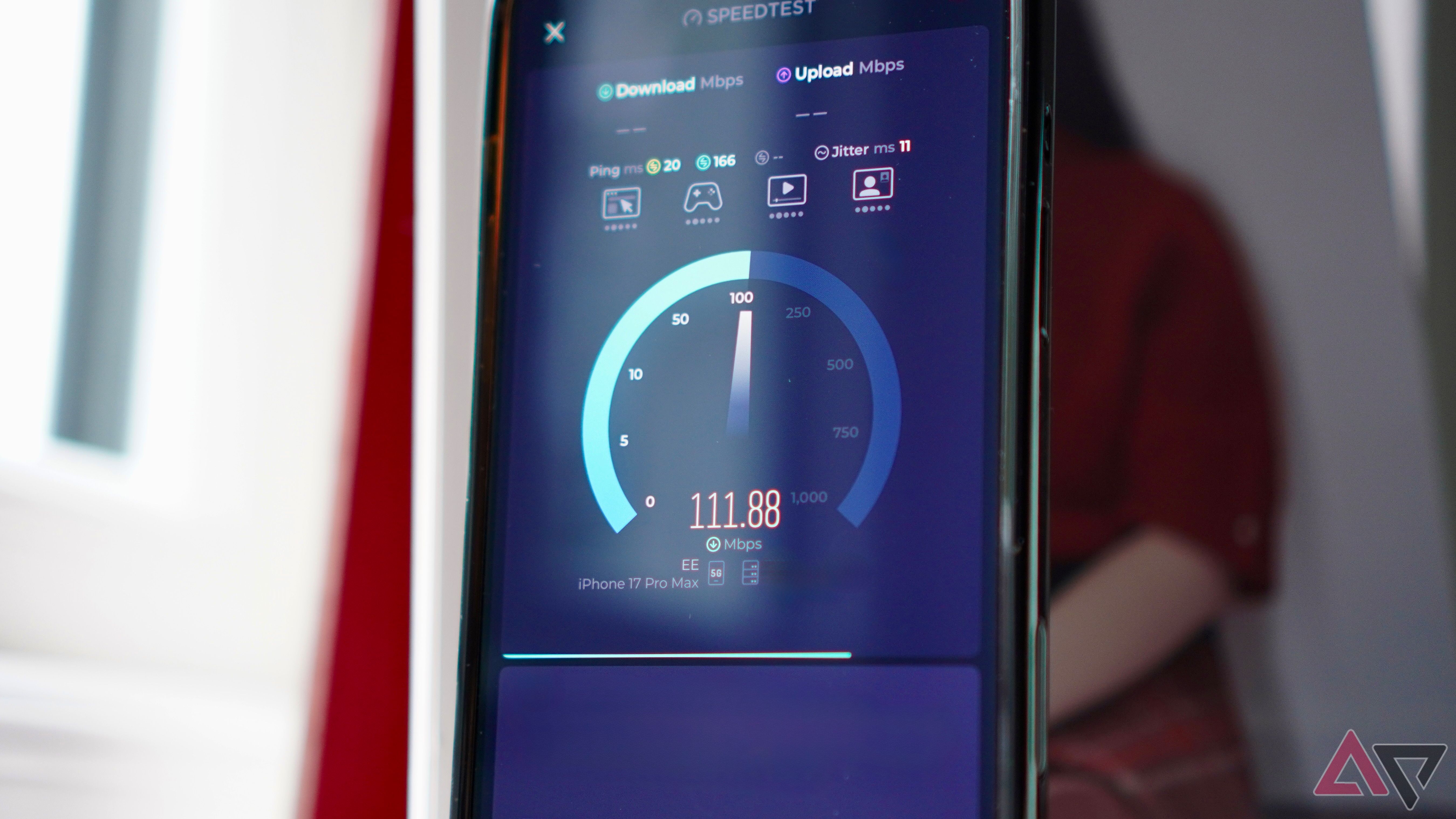
I also ran the same 4G and 5G tests on an Apple iPhone 17 Pro Max to see whether the modem, processor, and software altered the situation. Speeds were very similar.
What about latency, the other big 5G selling point? The OnePlus 15’s 4G results showed a 325ms download ping, a 630ms upload ping, and a 25ms idle ping.
In the 5G test, the idle ping was 26ms, but the 118ms download ping and 342ms upload ping were definite improvements. The iPhone also had similar gains.
A UK thing?
No different elsewhere

Perhaps the UK’s 5G network isn’t as robust as other regions?
To see if my 4G and 5G test results were outliers, Android Police’s Stephen Radochia ran the same Ookla test in the US.
On 5G, he achieved 134Mbps download and 12.1Mbps upload, and 126Mbps download and 7.4Mbps upload on 4G LTE.
The numbers tell a similar story to my results: 5G isn’t dramatically faster than 4G, and while his latency results weren’t as low as the ones I recorded, this was still the main area where improvements can be spotted.
Do they make a difference in real life?
In an explainer from 2019, Qualcomm writes that low latency will benefit online multiplayer games, make VR videos play without buffering, and enable autonomous cars and remote surgery in the future.
I’ll let you know how 5G works out for me after I do all those things.
A disappointment?
Not entirely

Now 5G has arrived at home for me, six years after I first tested it. I admit the speeds are a disappointment. However, I’m not disappointed by the upgrade to the network in my area.
Over the last four years, the signal has been awful, often with a single bar of reception in my house. I have relied on home internet and Wi-Fi Calling to get anything done.
5G’s arrival may not have changed my life, but the cell tower upgrade in general has.
I now have three bars of reception on my phone (but two on my iPhone), and calls, data, and the speed tests are all possible without a problem.
Before, it barely connected solidly enough for data at all.
There is a part of me that hates how pleased I am to have a mobile network that now operates at a level sufficient for general use, especially in 2025.
But if adding mediocre 5G upgrades enabled it, then I welcome 2019’s cutting-edge tech with open arms.
Now, I wonder what 6G will bring? I’ll find out in 2036, I expect, but based on 5G’s arrival, I’ll keep my expectations in check.
-
 Phones
 The Samsung Galaxy S25 is boring, but it's exactly what I needed
 Which phones support Wi-Fi 7?
 I used the Samsung Galaxy S25 Ultra and OnePlus 15, and one makes me angry

