
 By
Andy Boxall
Published 9 hours ago
Andy is a seasoned technology journalist with more than 15 years experience in the mobile industry, writing for Digital Trends, Wired, and more. During that time he has reviewed hundreds of smartphones and tablets, dozens of smartwatches, and a host of smart rings and smartglasses too.
His daily mobile tech life includes Android and iOS devices, smart rings, and a smartwatch unless it's a special ocassion, when a traditional watch takes its place on his wrist. He has attended multiple CES, MWC, and IFA tradeshows, has a passion for photography and cars, listens to far too much K-pop, and always has a strong opinion on the state of the tech industry.
You can find Andy's portfolio of work on his Authory page.
Sign in to your Android Police account
Add Us On
Summary
Generate a summary of this story
follow
Follow
followed
Followed
Like
Like
Thread
Log in
Here is a fact-based summary of the story contents:
Try something different:
Show me the facts
Explain it like I’m 5
Give me a lighthearted recap
By
Andy Boxall
Published 9 hours ago
Andy is a seasoned technology journalist with more than 15 years experience in the mobile industry, writing for Digital Trends, Wired, and more. During that time he has reviewed hundreds of smartphones and tablets, dozens of smartwatches, and a host of smart rings and smartglasses too.
His daily mobile tech life includes Android and iOS devices, smart rings, and a smartwatch unless it's a special ocassion, when a traditional watch takes its place on his wrist. He has attended multiple CES, MWC, and IFA tradeshows, has a passion for photography and cars, listens to far too much K-pop, and always has a strong opinion on the state of the tech industry.
You can find Andy's portfolio of work on his Authory page.
Sign in to your Android Police account
Add Us On
Summary
Generate a summary of this story
follow
Follow
followed
Followed
Like
Like
Thread
Log in
Here is a fact-based summary of the story contents:
Try something different:
Show me the facts
Explain it like I’m 5
Give me a lighthearted recap
Before we get into the RayNeo X3 Pro, I want you to ignore the look of these smartglasses for a bit. It's important, because the technology inside them, specifically the screen, is so cool, I don't want them to be overlooked because, well, they're as geeky-looking as glasses can get.
No, these aren't prototypes, this is the final design, and to access the futuristic joy of screens in a pair of smartglasses, you're going to have to accept looking a bit silly. Let's get into whether it's worth it.
 RayNeo X3 Pro
 6/10
Sunglasses?
N
Connective Technology
Bluetooth 5.2 / Wi-Fi 6
Brand
RayNeo
Speakers
Y
6/10
Sunglasses?
N
Connective Technology
Bluetooth 5.2 / Wi-Fi 6
Brand
RayNeo
Speakers
Y
The RayNeo X3 Pro's fantastic screen makes these smartglasses futuristic and exciting, and are a true glimpse at the future of these devices. Unfortunately, you're going to look weird wearing them.
Pros & Cons- Amazing screen technology
- Lightweight
- Hands-free Google Gemini
- Challenging design and style
- Short battery life
Specs, price, and availability
The RayNeo X3 Pro smartglasses come in a single style and cost $1,299. At the time of writing, there is an early-bird offer reducing that price to $1,099. Prescription lenses are also available as inserts and start at $49.
What can you buy instead? The Meta Ray-Ban Display use similar display technology, but are considerably cheaper at $799 without prescription lenses. The Even Realities Even G2 are $599 and have a single-color screen. The Halliday Smart Glasses use a different type of display entirely, and cost $500 without prescription lenses. Finally, if you want smart glasses and aren't bothered about a screen, the Ray-Ban Meta remains the best buy.
Specifications Sunglasses? N Connective Technology Bluetooth 5.2 / Wi-Fi 6 Brand RayNeo Speakers Y Weight 76 grams Resolution 640 x 480 Field of view 30-degrees Sensors Accelerometer / Gyroscope / Magnetometer / Ambient Light Sensor / Wear Detection Prescription Availability Y Expand CollapseThe screens look great
Clear and bright

Let’s begin with the best part about the RayNeo X3 Pro: its incredible Binocular Diffractive Waveguide screen.
The smartglasses use a MicroLED display with a 640 x 480-pixel resolution, and an average 3,500 nits brightness. Look closely at the lenses, and you can see the outline of the screens, but when you’re wearing the glasses, they’re invisible until the screen activates. I tried, but unfortunately, you can't photograph the screen.
When the screen lights up in front of your eyes, I challenge you not to say “wow.” It’s clear, colorful, sharp, and vibrant. The way the menus and screens overlay the real world is genuinely futuristic, and it encourages you to forget the design and put them on your face, just so you can marvel at the way the screen glows.

The brightness impresses, and the 6,000 maximum brightness ensures it’s easy to see in low and daylight conditions, plus there’s no obvious blur. It’s everything the Halliday Smart Glasses' screen isn’t, and using the RayNeo X3 Pro reminded me what’s missing from the Ray-Ban Meta smartglasses.
It's impossible to truly describe how cool the screen looks, and how futuristic it feels to see it overlay the real world when you're out and about. Even though I've worn the RayNeo X3 Pro quite a bit, seeing the screen hasn't even started to get old. There's huge potential in smartglasses with screens, and the RayNeo X3 Pro is a tantalizing glimpse of what's possible.
Software works well
But functionality frustrates
You control the RayNeo X3 Pro using touch panels in both arms, with the right side controlling menus and features, and the left for volume and media playback. You can also talk to the built-in AI assistant, which is based on Google Gemini.
The menus are icon-based and logical, and it takes no time to learn how to use the glasses, but the double-tap to go back a step is less intuitive than a swipe down. The “Hey RayNeo” wake command for the AI is moderately responsive, but I find the manual system of waking up the menu using a side button slow and rather old-fashioned.
With a screen this beautiful, you want to use the X3 Pro, but unfortunately, there isn’t all that much to do with them. You can chat to the AI, but it’s hardly a unique feature. It helped me make coffee in my espresso machine, and provided some guidance on measurements, but it was nothing Gemini on my phone, Gemini on my Pixel Watch 4, or Meta’s AI in the Ray-Ban Meta can’t do.
Games and apps
You'll have to work for them
 RayNeo X3 Pro (top) and Ray-Ban Meta
We’re overloaded with chances to ask AI anything, making the hands-free nature the only benefit of using it on the RayNeo X3 Pro. Even then, you have to manually enter a video call for it to “see” what you’re seeing, and doing so puts massive strain on the battery, which I’ll come back to in a while.
There are a couple of games made for the X3 Pro to try, a very cool maps feature, which uses Here Maps, where you can see your route on the screen as you walk around, meeting transcriptions, translation, and a teleprompter mode.
The smartglasses are supposed to interact with Instagram, WhatsApp, and TikTok, but to do so, you have to sideload the apps using the Android Debug Bridge from a computer, which was so long-winded and confusing I stopped caring. Notifications didn’t work for me either, with the app on the phone obstinately turning the feature off after I turned it on.
Good audio performance
Over-sensitive controls

Play music on your phone to hear it through the RayNeo X3 Pro’s speakers, which sound great, easily matching the Ray-Ban Meta's speakers. There’s not much bass, as you’d expect, but a lovely wide stereo separation and clear vocals.
However, the X3 Pro is easily confused. An accidental tap of the arm will call up the voice assistant during music playback, plus when you swipe to change the volume, nothing actually happens, and you have to adjust the volume on your phone. The touch controls can also be really sensitive, and the software sometimes ponderous, resulting in further frustration as you try to reach the desired option or change a setting.

The smartglasses connect to the RayNeo AR app, which I’ve been using on the OnePlus 15R. The app is also available for iOS. From here, you can activate some of the features, such as maps and the teleprompter. There’s plenty of Android-related permissions and settings to adjust, but it has worked reliably.
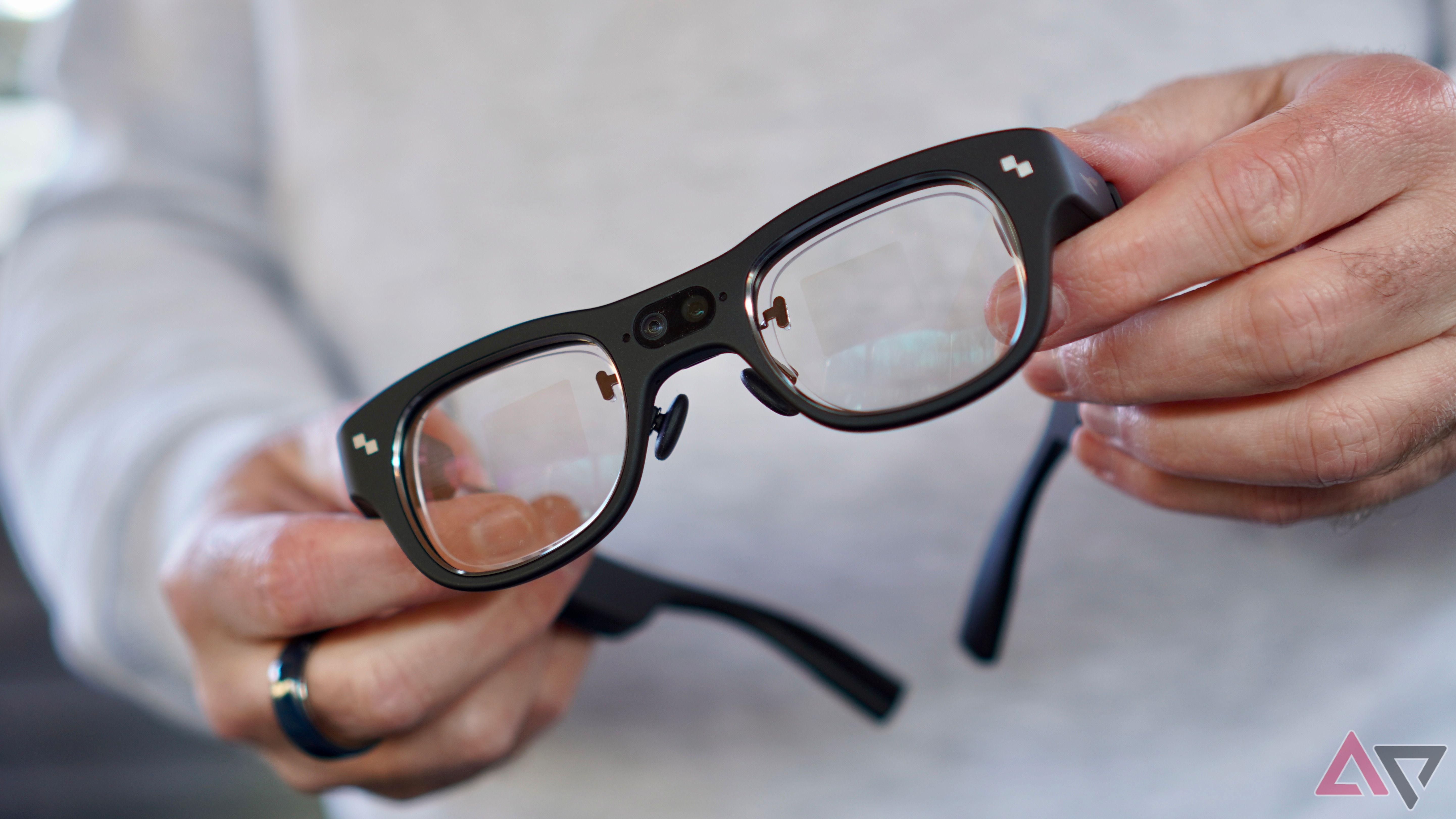
In the center of the nosebridge, and adding to the weird looks, is a camera which can take stills and video. Like the Ray-Ban Meta it shoots in portrait orientation, and images can be downloaded to your phone.
There doesn't seem to be a timer delaying capture, and I missed being able to take those first-person shots that make the Ray-Ban Meta's camera fun. In the app there's a handy horizon fix tool, as photos taken with a camera on your face rarely have a level horizon.
While it sounds like a lot, the RayNeo X3 Pro is not as useful as you may expect. The camera is fine, but your phone takes better photos, and there are features that don’t work, some interface confusion, and the usual array of AI modes that will only be helpful in very specific situations. You’ll want to see and use the screen, but there simply aren’t that many opportunities to do so.
Wearing the RayNeo X3 Pro
Comfort, without the looks

If the RayNeo X3 Pro were incognito and flew entirely under the radar, I could somewhat forgive the lack of meaningful, everyday features to use. But they’re far from it, and everyone is going to notice them, but not in a good way.
The frames and arms are oversized, the lenses are a little small, and there’s a camera right in the center. They’re highly noticeable, and obviously techy. There’s nothing subtle, stylish, or normal about them, and you’re going to have to put up with odd looks and comments wearing them out in public. I know I did.
That said, they’re not especially uncomfortable due to the low 76 gram weight, and I really like how the frame is matte and not gloss, meaning it has the potential to suit more faces.

A further issue is getting them to sit right on your face. For me, the arms are a little too short, and provide little side grip, so they constantly feel like they’re going to fall off, particularly because most of the weight is at the front of the frames.
I also found the screen is set quite low in my field of vision, and I had to have the smartglasses perched on the end of my nose, or squashed down on the bridge, to see it all. There’s no option to adjust the location of the display in the app or settings menu.
There’s no headtracking to activate the screen, and to wake it up you have to press a button on the underside of the right arm, plus I found the wear detection feature to be unreliable, and whether it worked or not depended on how tightly pressed the glasses were against my face.
Prescription lenses
Different nose pads too

I wear glasses to see, and RayNeo supplied prescription lenses with the X3 Pro so I could actually use them. Due to the nature of the screen and lenses, the prescription is added into a second set of lenses, which are clipped to the nose bridge on the inside of the smartglasses.
It’s a neat solution, and I haven’t found any vision issues caused by the unusual placement. The fitment is sturdy, so I never had any concern about the lens insert coming loose. The X3 Pro comes with two nose pad options, one longer and wider, and the other shorter and less wide. Both can be shaped to fit your nose, but I didn’t find either helped position the screen more effectively than the other.
There’s never any substitute for having a qualified optician adjust glasses for your face, or having lenses measured specifically for your eyes, but I managed to get the X3 Pro’s lenses and nose pad set just about right for comfortable use.
Battery life and charging
Expect to visit the charger often

It’s a 245mAh battery inside the RayNeo X3 Pro, and it’s not up to the job of powering the smartglasses through the day, if you decide to use many of the features.
A 10-minute chat with the AI, including giving it access to the camera, takes at least 25% of the battery. Stream music for thirty minutes and it takes 12%. Play one of the games for five minutes (that’s all you’ll want to spend on them), and watch 10% disappear. Use the maps for 15 minutes, and 25% of the battery will be gone.
If you actually use the RayNeo X3 Pro smartglasses, you may only get an hour or two from the battery. During light use, like only streaming music, and if you get notifications working, it’ll last longer. But then you’ll be wearing these silly-looking smartglasses for no good reason.
The smartglasses are recharged using a USB-C cable plugged into the end of the arm, and it takes about 45 minutes to fully charge the battery. This is quick, which is a good thing as you’ll be plugging the smartglasses in a lot.
Should you buy the RayNeo X3 Pro?

The RayNeo X3 Pro cost $1,299 if you miss the $1,100 early-bird price, making it a very expensive gadget. The screen technology is the most impressive part, but it’s not worth such a high price to experience when the rest of the functionality is mostly available on your phone.
You’ll also be paying more than $1,000 to make yourself, if you’ll forgive the pun, a spectacle. For all their comfort, the RayNeo X3 Pro will make you look bizarre if you wear them out in the real world.
The RayNeo X3 Pro are a tantalizing look at the future of smartglasses. The screen tech is incredible, and I can’t wait for the hardware and functionality around it to catch up. When it can be packaged inside a pair of glasses with a less intrusive and gawky design, I won’t feel so self-conscious wearing them. Unfortunately, at this time, the screen is not worth the price of admission on its own.
RayNeo X3 Pro
6/10
Sunglasses?
N
Connective Technology
Bluetooth 5.2 / Wi-Fi 6
Brand
RayNeo
Speakers
Y
As a demonstration of how transformative a screen inside a pair of smartglasses can be, the RayNeo X3 Pro do a superb job. Unfortunately, in the real world, the limited functionality and prototype-style looks make them hard to recommend.
$1299 at RayNeo Expand Collapse-
 Smartwatches & Wearables
 I used the Google Pixel 10 Pro XL and Samsung Galaxy S25 Ultra; you already know which one to buy
 I used the Samsung Galaxy A56 and Galaxy A36; here's why you need to spend more
 Everyone hated the Rabbit R1. They were right, but now they're wrong

