Agents are sticking to their guns in recent Intel Index surveys, arguing that their existing pipelines look better than a few months ago — and that their hopes are higher for the year ahead. Their cautious optimism is about to be put to the test.
Inman On Tour
 Inman On Tour Nashville delivers insights, networking, and strategies for agents and leaders navigating today’s market.
For the third consecutive month, real estate agents surveyed by Intel have reported healthy trends in their client pipelines and clear but measured optimism for the year ahead.
Their responses in February kept Intel’s Client Pipeline Tracker metric near its highest level in years, dipping only slightly from its peak the month before.
Client Pipeline Tracker score in February: +11
- Previous score: +13 in December
- 12 months ago: +6 in February 2025
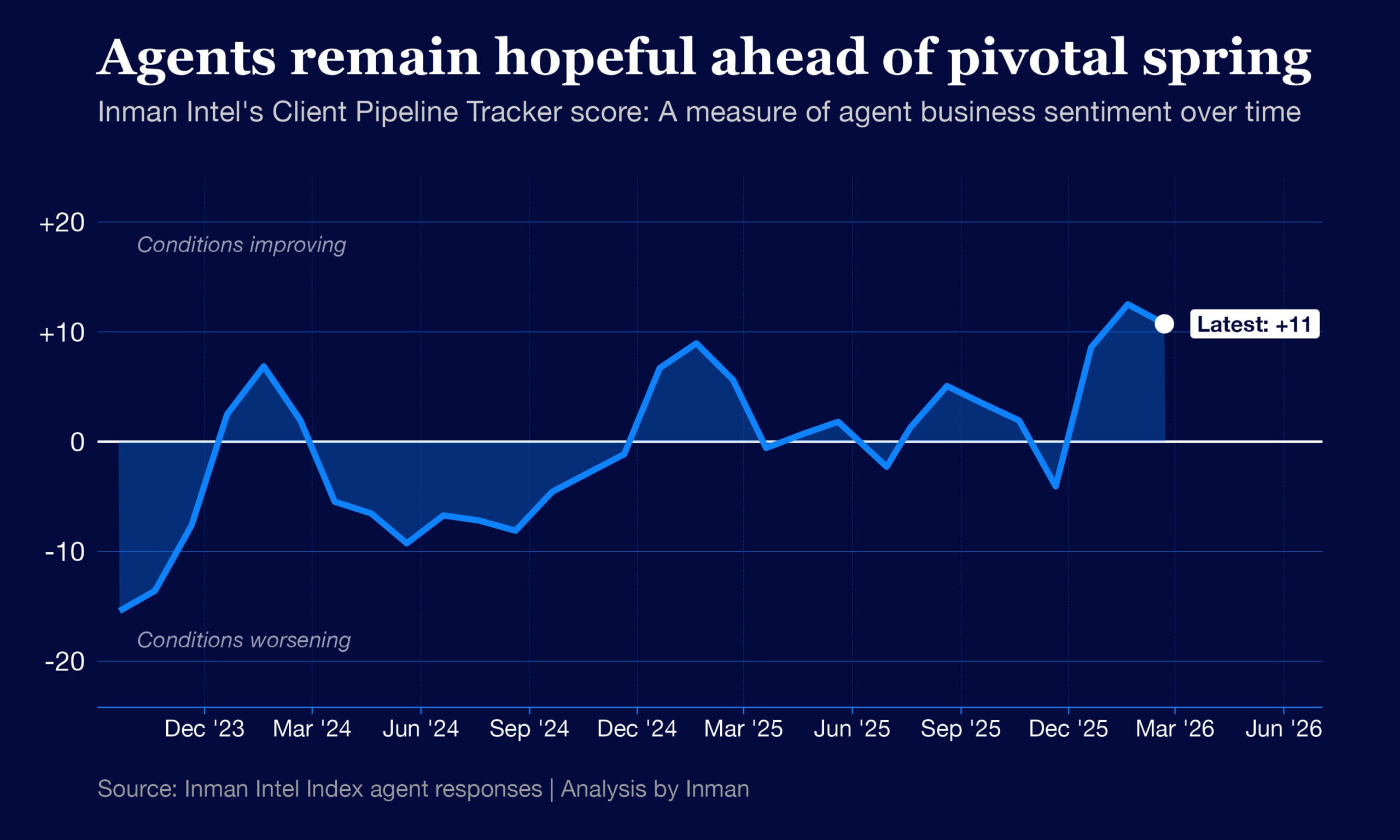
Chart by Daniel Houston
The improved sentiment in recent months was driven in part by agent conversations with potential clients ahead of the upcoming spring season. It also aligns with recent data that suggests steady improvements to affordability in this high-price, high-rate environment.
And while the surveyed agents were slightly less bullish in February than they were the month before, the results suggest agents have not been particularly moved by weakened pending-sales indicators from the mid-winter market.
Read about the components that went into the score in the full report.
Setting the stage
Intel’s Client Pipeline Tracker is a compilation of how agents feel about their buyer and seller pipelines — both over the past year and in the near future.
Intel described the methodology in this post, but here’s a quick refresher on how to interpret the scores.
- A score of 0 represents a neutral period in which client pipelines are neither improving nor worsening.
- A positive score reflects a market in which client pipelines have been improving, or are widely expected to improve in the next 12 months. The higher the rating, the more confident agents are that conditions are moving in a positive direction.
- A negative score suggests client pipeline conditions are worsening, or are widely expected to get worse in the year to come.
A significantly positive combined score falls around the +20 mark. This type of score would signify that much of the industry is in agreement that pipelines are improving and will continue to improve.
A significantly negative combined score, on the other hand, falls closer to -20. That’s a bit lower than where the industry stood in September 2023, the first time Intel surveyed agents about their pipelines.
For each of the four individual components that go into the score, results as high as +50 or as low as -50 are sometimes observed.
Here are the component scores from the most recent survey, and how each sentiment category changed from the previous one.
Tracker component scores
January → February
- Present buyer pipelines: -10 → -14
- Future buyer pipelines: +22 → +20
- Present seller pipelines: -1 → -3
- Future seller pipelines: +21 → +20
By late February, agents were slightly more cautious across the board than they were the month before.
- Buyer pipelines took the biggest hit, with the share of agents who reported their pipelines had worsened year-over-year growing from 34 percent in January to 41 percent the following month.
- The share of agents who said their buyer pipelines improved year-over-year remained unchanged over the same span, at 25 percent.
But taking a step back, it’s clear that buyer pipeline conditions remain on a significantly better trajectory than they were in 2025.
- Six months ago in August, 52 percent of agents said their buyer pipelines had worsened year over year — a share that was fairly representative of agent reports throughout the summer and fall.
- Only 16 percent of agents said that their pipelines were better off in August than they were the year before.
And in the other components of the Client Pipeline Tracker — including present-day listing conditions and future client prospects — agents aren’t far off where they were at their most optimistic in January. In fact, the number of real estate agents surveyed by Intel in February who expect their pipelines to improve in the coming year outnumbered 4-to-1 those who expect them to worsen.
- On the buyer side, 50 percent of surveyed agents said they expected pipelines to improve over the next 12 months, vs. 11 percent who thought they would lose buyers instead.
- On the listing side, 50 percent expected their pipelines to be better off a year from now, compared to 13 percent who expected them to be worse.
The optimism remains limited, to be sure. Few expect a sudden boom that pulls the market out of its years-long transaction slump.
But most agents Intel surveyed now expect something resembling a continued ramp-up in business momentum.
Is this time different?
While the survey results clearly indicate a level of optimism that hasn’t been seen among Intel survey-takers this time of year since at least 2024, there are some reasons for caution in our interpretation.
In the first two years that Intel asked its pipeline-related questions, agents recorded their highest level of optimism in January. In 2024 and 2025, pipeline-based sentiment ticked downward in February, then took a tumble in March.
It’s worth asking whether what we’re seeing in 2026 might be following a similar seasonal pattern — and setting these agents up for disappointment in the near future.
Intel tries to get around seasonal thinking by asking its pipeline questions in year-over-year terms. When assessing present-day pipelines in, say, February, agents are asked to compare them to February the year before. And when measuring the outlook for the future, agents are asked how they expect their pipelines will look in 12 months compared to today.
In theory, this should strip out some seasonal complications from agent sentiment. But it’s unlikely to account for seasonality perfectly across all responses.
On the other hand, there are some key explanations for the sudden downswings in March of 2024, and 2025 had more acute causes — ones that might not be repeated in the coming spring.
In March 2024, Intel surveyed agents beginning mere days after the National Association of Realtors announced the settlement terms in its longstanding commission litigation, which had implications for how agents made commissions and, some thought, whether buyers might end up on the hook for their agents’ fees.
Agent business sentiment plummeted in that survey, but it wasn’t because agents reported any actual thinning in their existing client pipelines. Instead, the steep decline in 2024 sentiment was almost entirely driven by agent expectations for their future buyer pipelines in the wake of the new rules.
In March 2025, agents appear to have soured significantly on their pre-spring optimism, due in part to concerns about the broader economy. By that point, the busy flurry of new, broad classes of tariffs on U.S. imports had begun to spook financial markets, which began their sudden downturn around the same time.
Agents once again appeared to adjust their pipeline expectations for the coming year downward, rather than their assessments of their existing client pools. And for much of the year after that point, agents expressed elevated concerns about the economy in Intel surveys.
So what does that mean for interpreting this year’s results? It’s hard to say for sure. It’s entirely possible that the number of serious buyers and sellers that materialize in the spring won’t line up with the expectations set by client conversations in recent weeks. And we can never rule out another shock to the economy, or to the industry, like what happened in each of the past two years.
But it’s worth noting that those previous downturns in agent sentiment coincided with unique events that had implications for real estate and the broader economy; that those downturns were largely limited to real estate agents’ expectations for the future, not a meaningful downturn in their actual client pools at the time; and that the growing agent optimism in this year’s surveys is fueled largely by actual conversation with buyers and sellers, not simply by rosier predictions for the months ahead.
Regardless, Intel’s March survey could be telling as agent assumptions are finally put to the test.
Methodology notes: This month’s Inman Intel Index survey ran from Feb. 19-26, and had received more than 880 responses by Thursday morning. These results are preliminary and may be revised. The entire Inman reader community was invited to participate, and a rotating, randomized selection of community members was prompted to participate by email. Users responded to a series of questions related to their self-identified corner of the real estate industry — including real estate agents, brokerage leaders, lenders and proptech entrepreneurs. Results reflect the opinions of the engaged Inman community, which may not always match those of the broader real estate industry. This survey is conducted monthly.
Email Daniel Houston
Topics: buyer's agent | listing agent Show Comments Hide Comments Sign up for Inman’s Morning Headlines What you need to know to start your day with all the latest industry developments Sign me up By submitting your email address, you agree to receive marketing emails from Inman. Success! Thank you for subscribing to Morning Headlines. Read Next Buyer, seller demand drives agent optimism to highest level in years
 Interactive dashboard: Explore results of January's Intel survey
 What agents say Compass should do next — in their own words: Intel
 More home-seekers say they'll buy. Will they be enough to save the spring market?
More in Inman Intel
More home-seekers say they'll buy. Will they be enough to save the spring market?
More in Inman Intel
 Interactive dashboard: Explore results of February's Intel survey
More home-seekers say they'll buy. Will they be enough to save the spring market?
What agents say Compass should do next — in their own words: Intel
Interactive dashboard: Explore results of February's Intel survey
More home-seekers say they'll buy. Will they be enough to save the spring market?
What agents say Compass should do next — in their own words: Intel
 Acquired brands are warming to Compass tech — but divided on Private Exclusives: Intel survey
Read next
Read Next
Buyer, seller demand drives agent optimism to highest level in years
Interactive dashboard: Explore results of January's Intel survey
 CoStar lays off staff amid Homes.com cost-cutting campaign
 Compass partners with Rocket-Redfin to display coming-soon listings